
Introduction
If you’ve ever watched the Winter Olympics, you’ve probably seen both field hockey and ice hockey and wondered — are they the same sport on different surfaces? The short answer is no, but the longer answer is more interesting than you might think. Field hockey and ice hockey share a common ancestor rooted in the stick-and-ball games played across Europe for centuries, but they’ve evolved into two completely distinct sports with different rules, equipment, skills, and cultures. Whether you’re trying to decide which one to play, or you’re just a curious sports fan, this guide breaks down everything you need to know.
A Quick History of Both Sports
Field Hockey’s Origins
Field hockey in its modern form was codified in 19th-century England, but versions of the game have been played for thousands of years. The ancient Greeks, Romans, and Egyptians all had stick-and-ball games. The Persians played a game called “polo” on horseback, and the Irish played “hurling” — both relatives of modern hockey. Field hockey became an Olympic sport for men in 1908 and for women in 1980. Today, it’s especially popular in India, Pakistan, the Netherlands, Australia, Germany, and Argentina. In fact, field hockey is the second-most popular sport in the world by participation numbers, after football.
Ice Hockey’s Rise
Ice hockey developed in Canada in the late 19th century, drawing inspiration from field hockey and other stick-and-ball games adapted for frozen ponds. The first organized indoor game was played in Montreal in 1875, and the sport spread rapidly across North America and Europe. The National Hockey League (NHL) was founded in 1917 and is now one of the world’s major professional sports leagues. Ice hockey became an Olympic sport in 1920 (summer games, believe it or not) and moved to the Winter Olympics in 1924. It’s the national sport of Canada and commands massive followings in the United States, Russia, Sweden, Finland, and the Czech Republic.
The Playing Surface
This is the most obvious difference, and it affects everything else about the two sports.
Field Hockey
Played on grass or, more commonly today, artificial turf. The pitch is 100 yards long and 60 yards wide — about the same size as a football pitch. The surface is flat and predictable, which means the game is played primarily on the ground. Passes and dribbles stay low, and the ball rolls true. Players wear cleats or turf shoes for traction.
Ice Hockey
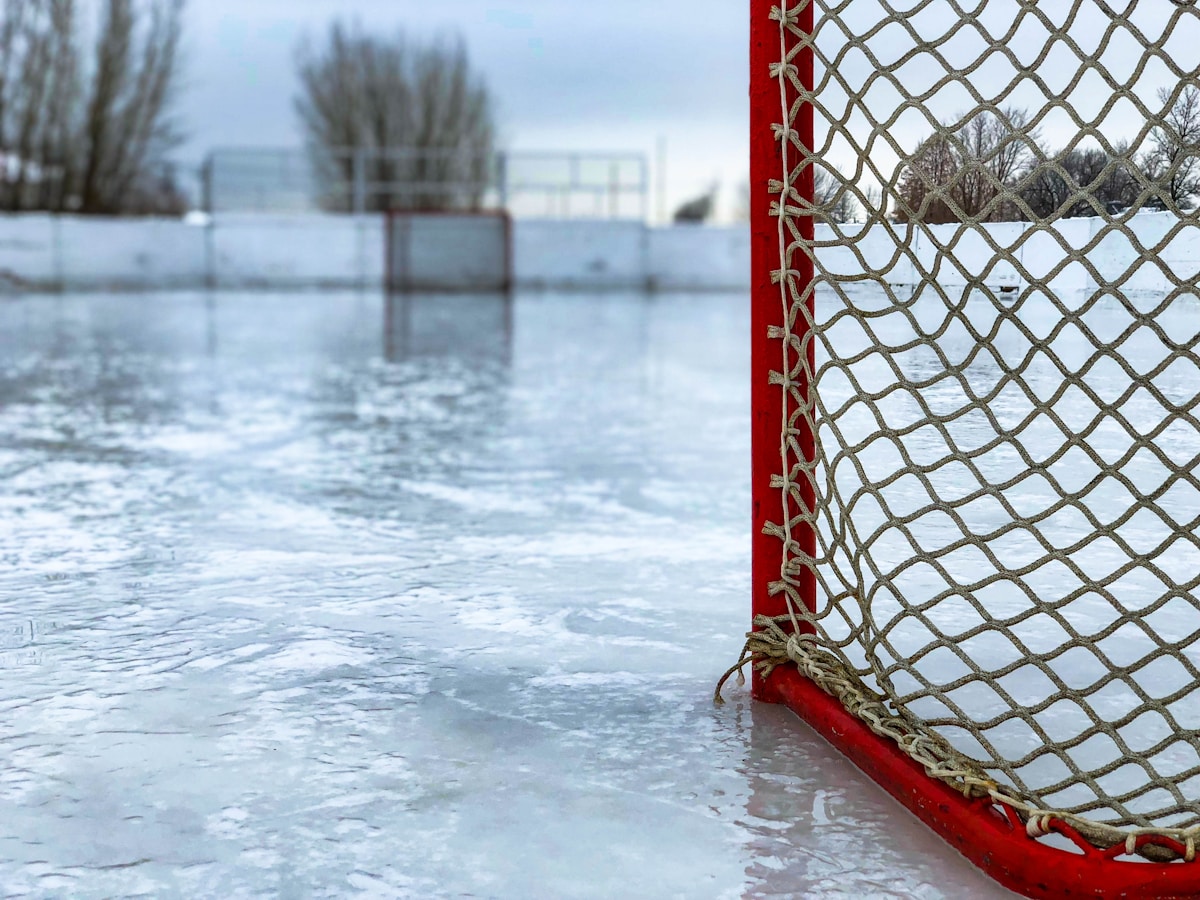
Played on an ice rink, which is much smaller — about 200 feet long and 85 feet wide (roughly 67 by 28 yards). The ice surface means players glide rather than run, and the puck can be lifted into the air using a technique called “saucering.” The smaller playing area makes ice hockey faster and more physical, with players constantly in contact with each other and the boards surrounding the rink. Players wear ice skates, and the ability to skate well is the single most important skill.
Equipment: A Tale of Two Levels of Protection
Field Hockey Equipment
- Stick: A J-shaped stick, traditionally made of wood but now often composite. The flat face is used on the left side only — you cannot hit the ball with the rounded back. Stick length varies from about 36-39 inches depending on the player’s height.
- Ball: A hard, solid sphere about the size of a tennis ball but heavier, weighing 5.5-5.75 ounces. Usually white but can be colored for visibility.
- Protective gear: Shin guards, mouthguard, and sometimes gloves. Goalkeepers wear extensive padding including leg guards, kickers, chest protector, helmet, and hand protectors.
- Footwear: Cleats or turf shoes. Nothing special required.
Ice Hockey Equipment
- Stick: A long, straight shaft with a flat blade at the end. Made of wood or composite. The blade has a slight curve — the direction of the curve determines your shot style (left or right handed).
- Puck: A vulcanized rubber disc, 3 inches in diameter and 1 inch thick, weighing about 6 ounces. Frozen before games to reduce bouncing.
- Full protective gear: Helmet with cage or visor, shoulder pads, elbow pads, gloves, shin guards, hockey pants, pelvic protector, and neck guard. This is mandatory at all levels, not optional.
- Skates: Specialized boots with steel blades. The quality of your skates dramatically affects your performance. Expect to spend at least $150-$200 for a decent pair of entry-level skates.
Rules and Gameplay
Number of Players
Field hockey has 11 players per side (including the goalkeeper). Ice hockey has 6 players per side — three forwards, two defensemen, and one goaltender. The smaller team size on ice means each player covers more relative space and the game has more end-to-end action.
Game Duration
A field hockey match is divided into four quarters of 15 minutes each (60 minutes total, plus stoppage time). An ice hockey game has three periods of 20 minutes each (60 minutes of regulation time, but the clock stops on every whistle, so real-time duration is usually 2-2.5 hours).
Movement and Offside Rules
In field hockey, you cannot play the ball above shoulder height, and all shots must be taken from within the striking circle (the D-shaped area in front of the goal). There’s no offside rule, which makes for more fluid attacking play. In ice hockey, the puck can be played at any height (including lifted shots), and there are strict offside and icing rules. Offside means an attacking player can’t enter the offensive zone before the puck crosses the blue line. Icing means you can’t shoot the puck from your own half across the opponent’s goal line without it being touched — it’s a way to prevent defensive teams from just clearing the puck endlessly.
Physical Contact
This is probably the biggest difference. In field hockey, physical contact is limited — you can’t push, charge, or use your body to impede an opponent. Body checking is illegal. It’s a non-contact sport that relies on stick skills and positioning. In ice hockey, body checking is legal and expected at most levels of play. Fighting, while technically against the rules, has historically been tolerated in professional hockey (though it’s becoming less common). The physicality of ice hockey is a defining feature — players hit, battle along the boards, and fight for position in front of the net.
Scoring
Field hockey games typically end with scores around 2-1 or 3-2. Goals are relatively rare because the ball must be struck from within the circle and the goalkeeper is well-protected. Ice hockey games also tend to be low-scoring by mainstream standards — typical NHL scores are 3-2 or 4-3. But the pace of play creates far more scoring chances, just with less conversion rate due to the smaller nets and elite goaltending.
Skills and Training
Field Hockey Skills
- Dribbling: Indian dribble — a technique using rapid side-to-side stick movement to keep the ball close while running at full speed.
- Passing: Hit, push, and slap passes — each used in different game situations.
- Flicking: A wrist-powered lifting technique used to score over the goalkeeper’s shoulder or pass in crowded areas.
- Stickwork: Because you can only use one side of the stick, reversing the stick to play the ball on the right side is a key skill.
Ice Hockey Skills
- Skating: Forward stride, backward skating, crossovers, transitions, and stops. This is the hardest skill to learn and the most important one.
- Stickhandling: Controlling the puck while moving at speed, often while being checked.
- Shooting: Wrist shot, snap shot, slap shot, and backhand — each with different mechanics and use cases.
- Body checking: Proper technique for delivering and receiving hits safely.
Which Sport Should You Choose?
Here’s the honest answer: it depends on what’s available where you live. Field hockey is more accessible globally — you just need a stick, a ball, and a flat field. Ice hockey requires ice time, skates, and significantly more expensive equipment. In North America, ice hockey is the more popular version; in Europe, Asia, Africa, and Australia, field hockey dominates.
If you’re choosing based on the experience itself: try field hockey if you prefer a strategic, skill-based game played at a steady pace with plenty of running and teamwork. Try ice hockey if you want high-speed action, physical contact, and the unique challenge of skating while handling the puck. Better yet: try both. Many skills are transferable — stickhandling, spatial awareness, and hockey IQ work in both sports. You might find you love them both for different reasons.
Conclusion
Field hockey and ice hockey are siblings, not twins. They share a lineage and a name, but they’ve grown into unique sports with their own demands and rewards. Field hockey is all about stick control, endurance, and tactical positioning — a game of inches and angles. Ice hockey is about speed, power, and split-second decision-making on a frozen, chaotic surface. Both are beautiful games. Both demand incredible athleticism and dedication. The choice between them isn’t about which one is “better” — it’s about which one speaks to you. Pick up a stick — whichever type — and find out.