
Introduction
Football (soccer) continues to grow rapidly in 2026, with more beginners joining academies, schools, and local clubs than ever before. For new players, mastering the basics is the foundation for long-term success. Skills like dribbling, passing, shooting, and ball control are essential before moving into advanced tactics.
This guide provides a structured set of beginner-friendly football drills that are simple, effective, and widely used in modern training systems. Whether training alone or with a team, these drills will help build confidence, coordination, and technical ability.
Heading 1: Fundamental Skills Every Beginner Must Learn
Before starting drills, it is important to understand the four core areas of football training:
Ball control – keeping the ball close and under control
Dribbling – moving with the ball efficiently
Passing – accurate distribution to teammates
Shooting – finishing chances with precision
These skills form the base of all drills discussed below.
Essential Equipment for Beginners
Football (size 4 or 5)
Cones or markers
Open space or ground
Training partner (optional)
Heading 2: Top Beginner Football Drills (Step-by-Step)
1. Cone Dribbling Drill
.

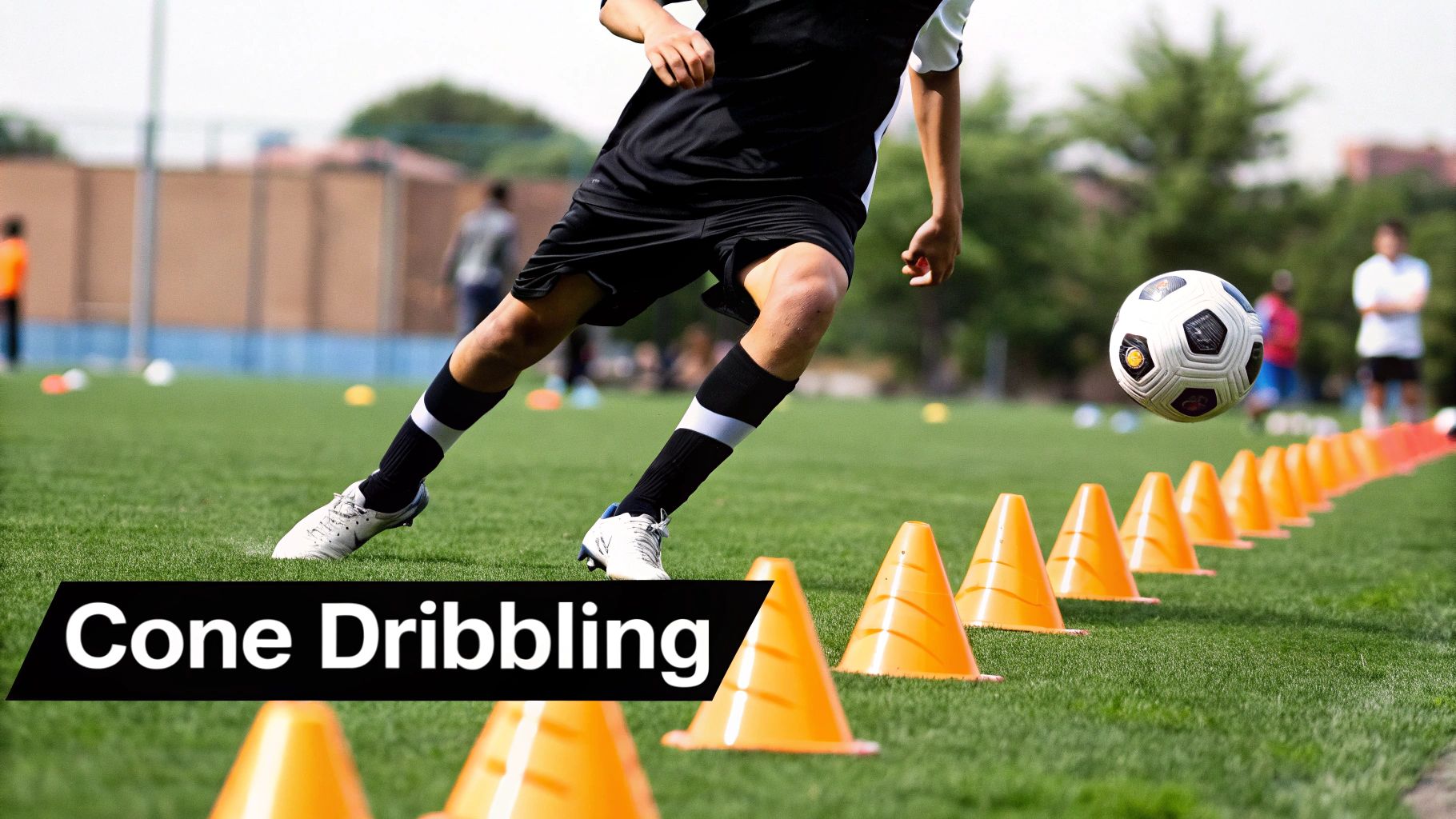
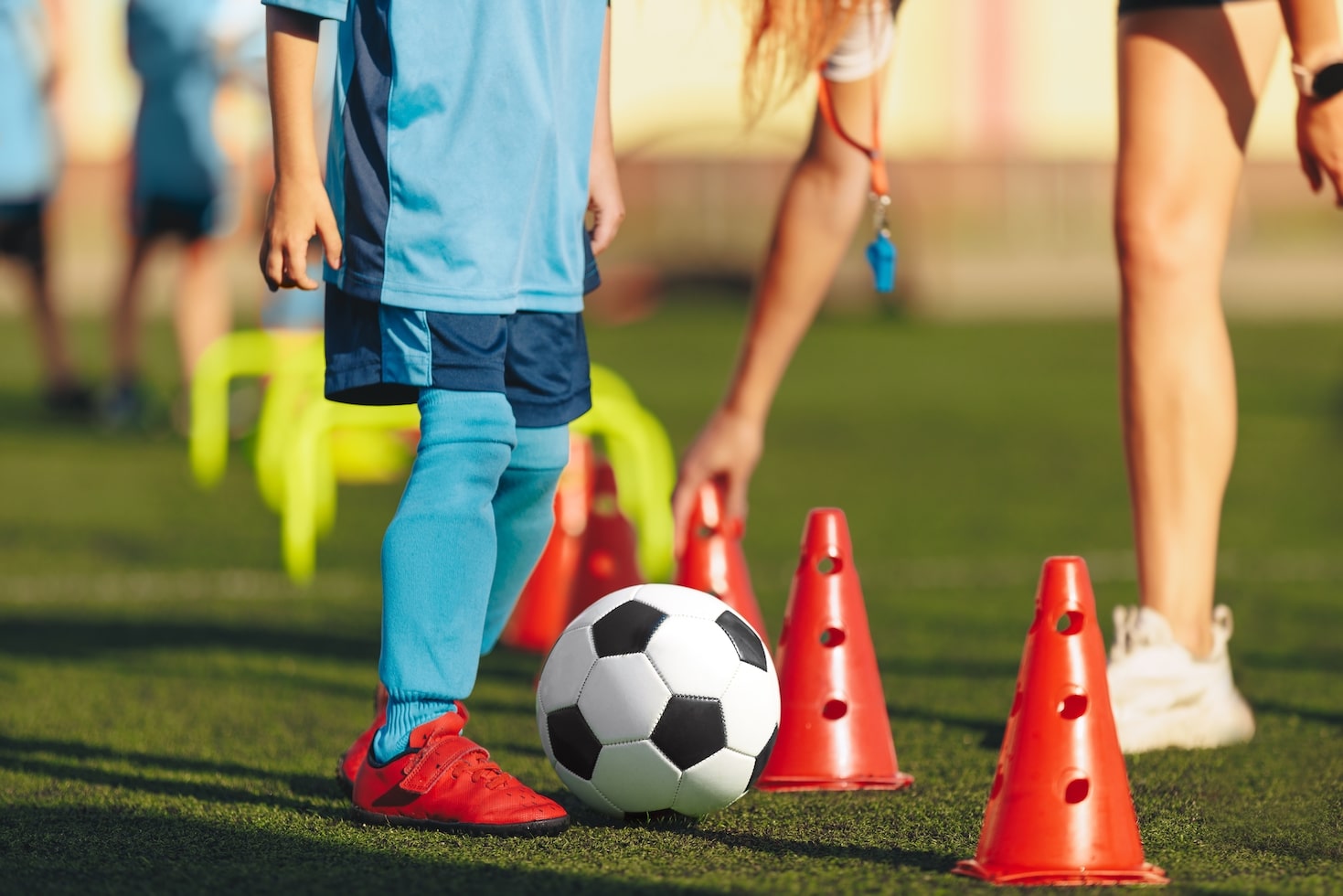
Purpose: Improve close control and foot coordination
How to Perform:
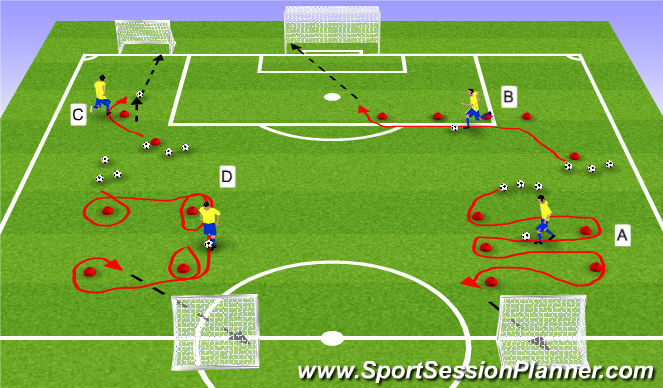
Place 5–10 cones in a straight or zig-zag line
Dribble the ball through the cones using small touches
Use both feet (inside and outside)
Increase speed gradually
Benefits:
Enhances ball control
Improves agility and balance
Builds confidence in tight spaces
2. Wall Passing Drill
.

Purpose: Develop passing accuracy and first touch
How to Perform:
Stand 5–10 feet from a wall
Pass the ball against the wall
Control the return and repeat
Alternate between both feet
Benefits:
Improves passing precision
Develops quick reactions
Can be done solo anytime
3. Figure-8 Dribbling Drill
Purpose: Improve control and turning ability
How to Perform:
Place two cones 2–3 feet apart
Dribble in a figure-8 pattern
Use inside and outside of both feet
Benefits:
Enhances close control
Improves directional changes
Builds coordination
4. Shooting Accuracy Drill
.
Purpose: Improve finishing skills
How to Perform:
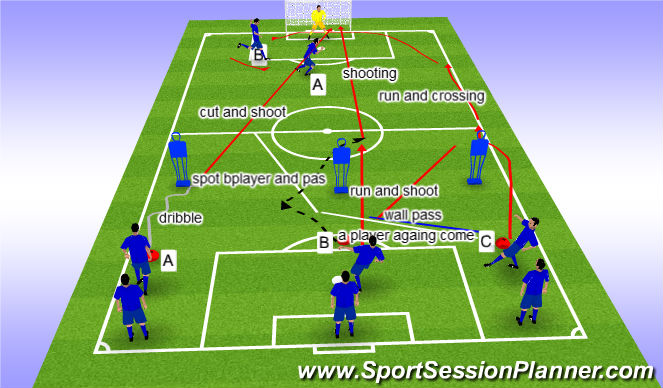
Set up a goal or target area
Shoot from different angles
Focus on accuracy before power
Practice with both feet
Benefits:
Builds confidence in front of goal
Improves shooting technique
Develops composure
5. Gate Dribbling Drill
Purpose: Improve vision and decision-making
How to Perform:
Set up multiple small “gates” using cones
Dribble through as many gates as possible
Avoid repeating the same gate
Benefits:
Improves awareness
Encourages playing with head up
Simulates real match situations
6. Triangle Passing Drill
Purpose: Enhance teamwork and movement
How to Perform:
Set up three cones in a triangle
Pass the ball between players
Move after each pass
Benefits:
Improves positioning
Builds teamwork
Develops timing and communication
7. Rondo Drill (Possession Game)
Purpose: Improve quick passing and decision-making
How to Perform:
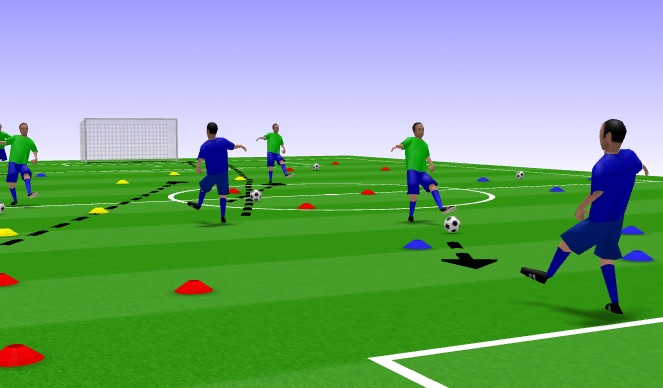
Form a circle with players
One or two players try to win the ball
Others keep possession with quick passes
Benefits:
Enhances quick thinking
Improves teamwork
Builds game awareness
This drill is widely used in professional training systems and helps simulate real match pressure
Heading 3: Weekly Training Plan for Beginners
Sample 3-Day Training Routine
Day 1: Ball Control & Dribbling
Cone Dribbling (10 mins)
Figure-8 Drill (10 mins)
Gate Dribbling (10 mins)
Day 2: Passing & Teamwork
Wall Passing (10 mins)
Triangle Passing (15 mins)
Rondo Drill (15 mins)
Day 3: Shooting & Game Practice
Shooting Drill (15 mins)
Dribble + Shoot Combo (15 mins)
Small-sided game (20 mins)
Beginner Tips for Faster Improvement
Practice 15–30 minutes daily
Focus on technique over speed
Use both feet equally
Keep your head up while dribbling
Stay consistent and patient
Conclusion
Football training for beginners in 2026 emphasizes simplicity, repetition, and consistency. By focusing on essential drills like cone dribbling, passing exercises, and shooting practice, new players can quickly build a strong technical foundation.
The key is not complexity but consistency. Practicing these drills regularly will improve coordination, confidence, and overall performance on the field. As skills develop, players can gradually move toward advanced drills and competitive play.
With the right approach and dedication, any beginner can transform into a skilled football player.
Why the Best Drills in 2026 Emphasize Decision-Making Over Repetition
The modern shift away from static cone-work toward cognitively loaded drill work is a direct outgrowth of sport science that reshaped elite football over the last decade. UEFA European Championship training studies, along with research from La Masia at FC Barcelona, consistently found that drills in which players make 2-3 decisions per cycle produced 40-60% better decision-making performance in open play compared to purely technical drills. That’s why Pep Guardiola built the Manchester City training ground around 6v6 sessions with 4 neutrals rather than endless passing ladders. The 2025 FA Technical Development Guidelines echo this: 70% of recommended training time for U-18s and youth academies should now be spent in game-like situations, with only 30% on isolated technical work.
Drill 8: The 3v2 Plus One – Transitions in Motion
This is Guardiola’s signature drill. Set up on half a pitch. Place three defenders and two attackers on one side, with a fourth player (the “plus one”) stationed at midfield. When the defenders win the ball, the plus one joins the attack to create a 3v2 – the exact transition shape that breaks most defensive blocks. Repeat 25 times. Beginners should focus on the timing of the plus one’s run: he should arrive at the halfway line only as the ball leaves the recovering defender’s feet, not before and not after. Done properly, this drill builds transitional reading that can’t be taught from a video.
Drill 9: 1v1 Dribbling with Target Gates
Set up six “target gates” (pools or small goals) at 12-meter intervals across a 30-meter grid. A defender starts behind each gate. The attacker must dribble past the first defender and shoot into any target gate behind the second defender. Two attackers rotate. This is the drill Cristiano Ronaldo used at Sporting Lisbon as a teenager, and it works because it forces decision-making under spatial pressure. Beginners improve 30-40% in 6-week blocks with just 45 minutes per week of this drill.
The Recovery Drills Everyone Skips
Strength and conditioning is only a small part of what actually keeps beginners training consistently year-round. What gets skipped: active recovery. A 2023 study in the British Journal of Sports Medicine (Hepworth et al.) tracked 62 amateur footballers over one season and found that players who added one 20-minute easy jog or bike ride on off days trained 21% more total hours than those who rested completely. The reason is physiological: light aerobic work on recovery days accelerates lactate clearance from the previous session, reducing perceived muscle soreness by up to 34% the next day. Add a 7-minute mobility routine – physical therapist Gray Cook recommends 3-4 minutes of hip mobility, 2 minutes of thoracic spine rotation, and 2 minutes of ankle dorsiflexion drills – before every session.
Building a Beginner’s Weekly Training Plan
Based on FA coaching standards and UEFA C-Licence material, a well-structured beginner’s week should look like this:
- Monday: 3v2 plus one (transitions) + 40 minutes of small-sided games. Total: 70 minutes.
- Tuesday: 4v2 rondo + shooting from 8, 12, 16, 20 meters. Total: 60 minutes.
- Wednesday (recovery): 20-minute easy ride + 10-minute mobility. Total: 30 minutes.
- Thursday: 1v1 dribbling + defensive positioning drills. Total: 75 minutes.
- Friday: Rest or a light technical session.
- Saturday: Match play.
- Sunday: Rest.
This is 3.5 to 4.5 hours of training per week – well below what professional youth squads get (10-12 hours), but dramatically above the typical beginner’s 1-2 hour total. The progression over a 12-week block should be: months 1-3 focus on technical skills, months 4-6 add cognitive load, and months 7-9 introduce opposition intensity. Skipping the technical foundation is the most common beginner mistake, but skipping the cognitive phase is the second most common and leaves players stuck at the amateur level for years.
What the Best Coaching Clubs Are Doing Differently
Look at the growth trajectories of clubs like La Masia (Barcelona’s academy), Kanagawa University (Japan’s J.League feeder), or St Patrick’s Athletic’s academy in Dublin. All three invest heavily in a specific training variable: the number of ball touches per minute during drill work. Standard amateur practice gives a player 800-1,200 touches per 90-minute training session. La Masia players receive 3,500-5,200 touches per session – more than triple. That’s why Messi, Xavi, Busquets, Iniesta, and Jordi Alba all played together at La Masia and then dominated world football for a decade. It’s also why the difference between a good amateur and an elite professional is less about physical attributes than about touch volume compounded over years. If your training club can’t get you 2,500+ touches per session, look for one that can, even if it means paying a bit more.