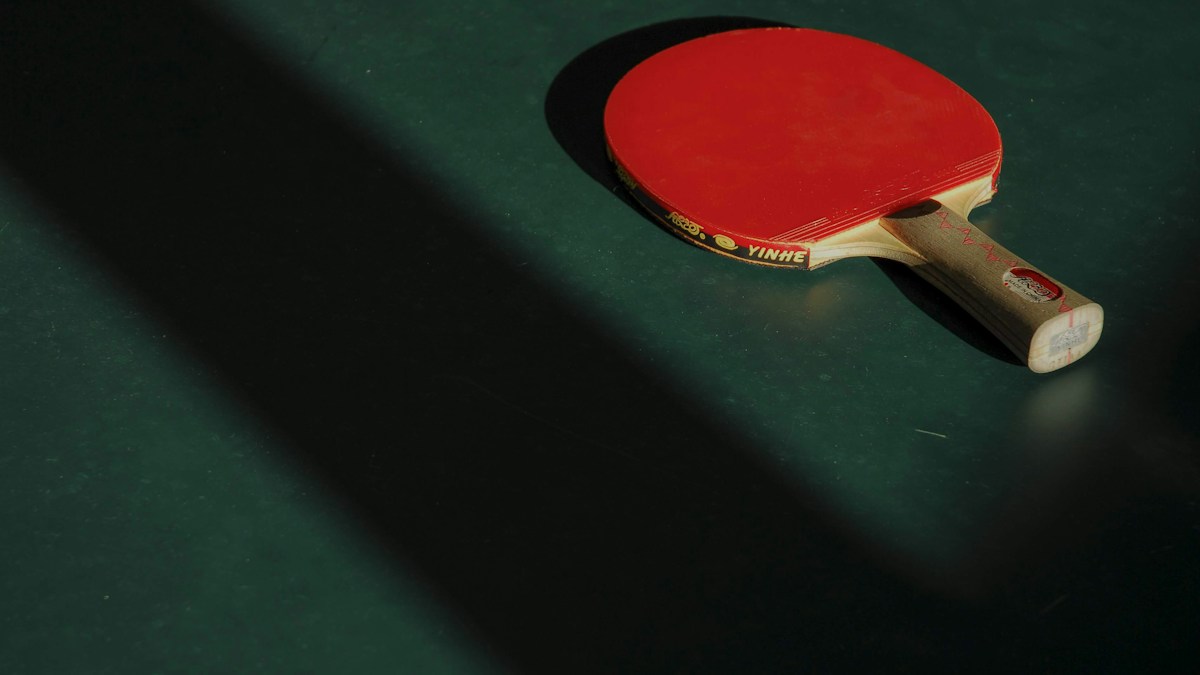
Table tennis was a different sport for most of its history, and I mean that in the most literal way possible. Not the rules, not the culture — the physics. The equipment has been redesigned so many times that a player who started training in the mid-1990s is effectively competing in a different game from the one they trained for, and most of that change happened without anyone in the stands noticing.
That’s the story. It’s genuinely one of the most under-reported equipment revolutions in any major sport.
The Big Switch: 40mm and the 40+1 Ball
The single biggest change came in 2000, when the International Table Tennis Federation (ITTF) moved from a 38mm to a 40mm white celluloid ball, part of an expansion designed to slow down the pace and make the game more spectator-friendly. That was then replaced by a non-celluloid, 40+1 plastic ball in 2014.
The number that matters is the mass difference. The 40+1 ball weighs 2.7 grams and has a tolerance of +/- 0.1g — much tighter than the old celluloid. What that changed:
- Spin dropped. Less mass means less spin transferred per contact. The top-spin heavy game of the pre-2014 era became measurably slower.
- Consistency improved. Celluloid balls absorbed moisture and varied match to match. The new balls fly almost identically across hundreds of games. That is a huge strategic shift for players who train on one ball type and compete on another.
- Service tricks got harder to hide. The tighter specs mean less variance to exploit on serve. The serve-and-receive game narrowed.
- Power became relatively more valuable than spin. When spin is capped, raw pace becomes the differentiator. That pushed the game toward power hitters.
The change was so significant that the sport held multiple World Championships to recalibrate. Players who had won medals on celluloid struggled to translate that to the new era almost overnight.
The Blade Arms Race
Meanwhile, the blades themselves went through their own transformation. Carbon-fibre layering moved from the very top end into mid-tier equipment, and the number of plies available in a competitive blade grew substantially.
The result is that a modern carbon composite blade offers dramatically faster rebound and higher energy return than a traditional pure-wood blade of the same thickness. The trade-off: control. A stiffer blade punishes a slightly off-centre contact far more severely than a wood blade ever did. Players adapted by building a more compact, higher-tension technique to compensate — which, in turn, changed how the entire game looks.
Rubber: The Silent Revolution
If I had to pick the single most consequential piece of equipment to change, it would be the rubber. Table tennis rubber has been the sport’s quiet technological frontier for decades, and here’s why:
- Chinese-made high-tension sponge rubbers became the standard for power players, offering enormous energy return that most of Europe and Japan simply couldn’t match for years.
- The ITTF banned a growing list of rubbers over the years because performance spread between approved and unapproved materials became too wide to justify leaving the field open.
- There was a push to standardize the playing surface entirely — the anti-plastic (anti-skid) rubber category, which is far less spin-dependent, has seen a slow but real rise in competitive use, because it levels the technical floor.
- The ITTF maintains a list of approved materials and has removed items from it more than once when a material advantage looked too dominant. That’s governance, not engineering.
In table tennis, the fastest way to change the sport isn’t the rules. It’s the rubber.
Why This Matters More Than People Realize
Here’s the thing most casual fans miss. Table tennis is a sport where the equipment is roughly 40% of the outcome, and that number isn’t rhetorical — it’s what the professional circuit has effectively decided through decades of equipment rotation. Change the rubber and you change who wins. Change the ball weight and you change the serve. Change the blade stiffness and you change the entire shot repertoire.
That’s an extraordinary amount of dependency for any major sport. Tennis and badminton have had their own equipment revolutions, but neither has restructured the competitive balance as repeatedly as table tennis has. The reason: the sport is too sensitive to small mechanical differences, because the ball is small, the table is small, and every millisecond of contact time counts.
The Serve: Where Technology Bit Back
The serve is the only shot a player takes completely unopposed, and it’s been the sport’s biggest competitive-balance problem for years. Modern serves can generate so much spin that the receiving player is essentially guessing. The ITTF has responded with:
- The rule change allowing the receiver to see the ball from two sides during the toss, killing the classic spin-hiding serves overnight.
- Ongoing scrutiny of rubber surface textures, because extreme spin generation is partly a rubber problem, not just a technique problem.
- Pressure on the serve as a strategic tool rather than a dominant one, which has, genuinely, made the game more interesting to watch.
I’ll be honest — the two-side rule was the single best change the sport has made in twenty years, and it’s a change that had almost nothing to do with equipment manufacturing and everything to do with how the existing equipment was being exploited.
Where We Are Now
Right now, table tennis is in a genuinely interesting place. The sport has:
- A plastic ball that has been in play for over a decade and is now the baseline.
- Rubber technology that continues to advance, with Chinese manufacturers still holding a meaningful edge on high-tension materials.
- A growing body of players from Europe, Korea and Japan who have closed the equipment gap considerably — the technology has become available to everyone, even if it’s not equally exploited.
- A persistent tension between the desire for a more open, spectator-friendly game and the reality that the fastest players in the world want maximum power and control.
My honest take: the next big equipment shift isn’t coming from the ball. It’s coming from the anti-plastic rubber category, which is quietly being adopted by a meaningful slice of the top-20 world ranking. The logic is simple — a rubber that generates less spin forces a higher-skill, more controlled game, and the players who adapt first will get the edge. That’s not speculation, it’s already visible in the ranking shifts.
The Underlying Lesson
Table tennis is a warning about how much of any sport’s character is decided by the equipment it allows. We talk about talent, training and strategy, and those matter. But in a sport as mechanically precise as this one, the ball weight, the rubber tolerance and the blade construction are doing a huge share of the work — and the governing body knows it, because it keeps intervening when the spread gets too wide.
That’s a genuinely uncomfortable realization for any sport that cares about competitive balance. The best answer isn’t to freeze the technology. It’s to standardize enough that the field stays fair, which is exactly what the ITTF keeps doing, year after year, without getting much credit for it.
The Blame Game Nobody Wins
Here’s an uncomfortable truth about equipment in table tennis: the ITTF’s interventions have been reactive rather than preventive. Each major rule change — the 40mm ball, the 40+1 ball, the serve visibility rule, the rubber approval list — was a response to a competitive imbalance that had already become obvious. The sport didn’t engineer a fairer game. It kept fixing an unfair one, which is a meaningfully different posture.
The consequence is that the game’s character has shifted several times in the last twenty-five years, and players of different eras genuinely play different versions of table tennis. A player who won a medal in 2003 was competing in a different mechanical environment than a player who won one in 2015, and neither had any control over the change. That’s a hard thing to reconcile with the idea of a continuous competitive lineage.
What Actually Changes Everything
My honest take on the next five years: the anti-plastic rubber category is going to become competitive-standard within the top 30 world rankings, and when it does, the game will look meaningfully slower and more controlled than it does today. Not because anyone asked for it — because the players who adopt it first will gain a real strategic edge, and the rest will follow.
The ITTF will almost certainly try to standardize further. They should. Every sport that’s sensitive to small mechanical differences needs a governing body that treats equipment governance as a competitive-balance problem, not a compliance problem. Table tennis has the body that can do it, and it has kept doing it for decades. That’s worth more credit than the sport gets.
Read the related threads: how table tennis became a mind game more than physical for the strategic layer that equipment enables, the science of spin: what makes Chinese players invincible for the rubber and technique side, the rise of European table tennis for how the gap closed, and why table tennis is the most underrated sport in the world for the broader argument. And if you’re chasing the crossover with other sports, why every grand slam winner studied table tennis first makes the case for why this sport’s technical base travels so well.