You do not need a gym membership, a rack of dumbbells or a single piece of expensive equipment to get fit. Bodyweight training — using your own body as resistance — is one of the most effective, accessible and time-efficient ways to build strength, improve conditioning and burn fat. You can do it in your living room, bedroom or garden, in as little as 20 minutes, with zero cost.
This guide gives you everything you need to get started and keep progressing: the reasons bodyweight training works, a complete library of exercises with correct form cues, three ready-made workouts for different fitness levels, and the simple principles that turn a routine into lasting results.
Why Bodyweight Training Works
Bodyweight exercises are mostly compound movements. Squats, push-ups, lunges and planks recruit multiple muscle groups and joints at once, which means more muscle activated per minute, a higher calorie burn, and better coordination and balance than isolated machine work.
They are also infinitely scalable. A push-up can be made easier by raising your hands on a table or dropping to your knees, or harder by raising your feet or adding a pause at the bottom. This built-in difficulty ladder is the key to progressive overload — the gradual increase in training stress that forces muscles to adapt and grow — without adding a single kilogram of weight.
- No cost, no commute: the only requirement is a small patch of floor
- Time-efficient: 20–30 minutes, three times a week is enough to see real change
- Joint-friendly: bodyweight loads are easier to manage than heavy barbells for beginners
- Functional strength: you train movement patterns you actually use every day
What You Need to Get Started
The equipment list is short: comfortable clothing, a non-slip surface or exercise mat, a towel and a bottle of water. If you have a sturdy chair or low table, it unlocks a few extra exercises such as tricep dips and incline push-ups — but they are optional extras, not requirements.
Before every session, spend five to ten minutes warming up: jumping jacks, arm circles, leg swings, hip openers and a few easy reps of the exercises you are about to do. A proper warm-up raises your heart rate, lubricates the joints and cuts the risk of injury. And if you have any existing injuries or health conditions, check with a professional before starting a new routine.
The Exercise Library
Lower Body
- Bodyweight squat: feet shoulder-width apart, chest up, sit back and down as if into a chair, knees tracking over your toes. 3 sets of 12–15
- Reverse lunge: step back, lower until both knees are bent to 90 degrees, drive through the front heel to return. 3 sets of 10 per leg
- Glute bridge: lie on your back with knees bent, drive your hips up and squeeze your glutes at the top. 3 sets of 15
- Calf raises: rise onto your toes from standing, pause, lower slowly. 3 sets of 20
- Wall sit: back flat against a wall, thighs parallel to the floor. Hold for 30–60 seconds, 3 rounds
Upper Body
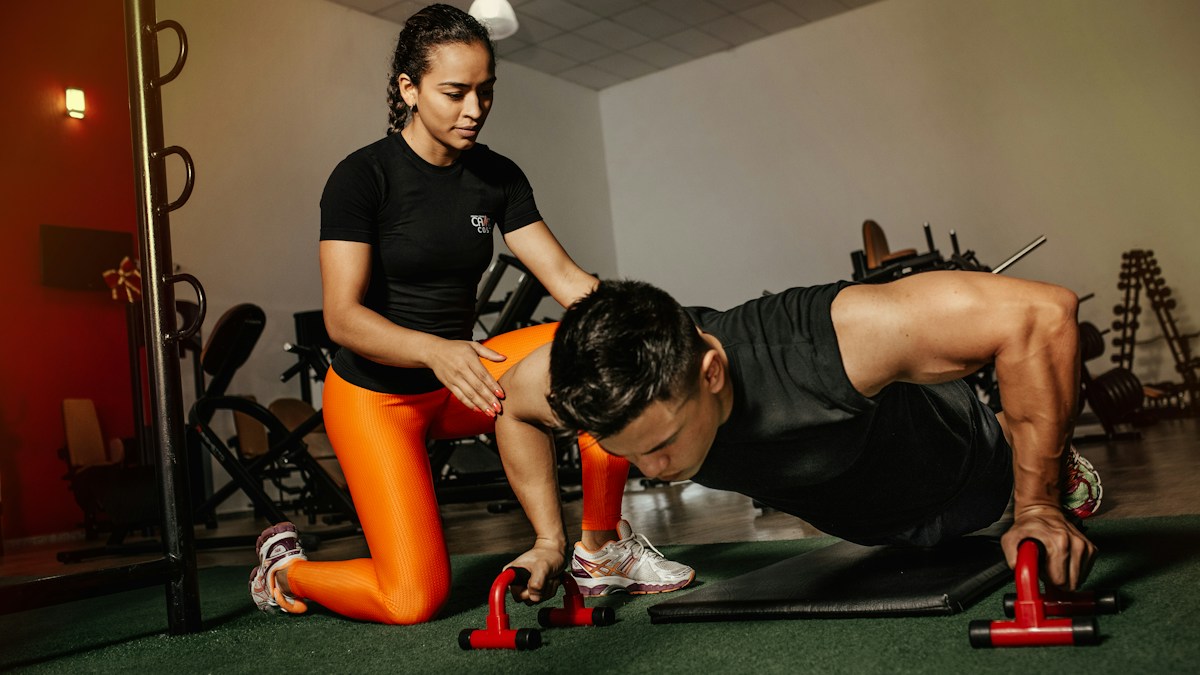
- Push-up: hands slightly wider than shoulders, body in a straight line, lower your chest to the floor and press back up. Beginners can use incline or knee push-ups. 3 sets of 8–15
- Pike push-up: hips high in an inverted V — this shifts the load to the shoulders. 3 sets of 8–12
- Tricep dip: hands on the edge of a sturdy chair, lower and press back up. 3 sets of 10–15
- Superman hold: lie face down, lift arms and legs off the floor and hold. 3 sets of 20–30 seconds
Core
- Plank: forearms on the floor, body in a straight line, brace hard. 3 sets of 30–60 seconds
- Side plank: on one forearm with hips lifted; add a hip dip for extra challenge. 3 sets of 20–40 seconds per side
- Dead bug: lie on your back with arms up, lower opposite arm and leg slowly without arching your back. 3 sets of 10 per side
- Bicycle crunch: alternate elbow to opposite knee in a slow, controlled pedalling motion. 3 sets of 20 total
- Mountain climbers: from a press-up position, drive knees to chest alternately, fast and light. 3 sets of 30 seconds
Full-Body and Cardio Finishers
- Burpee: squat, kick back to a plank, return, jump — the ultimate full-body move. 3 sets of 8–12
- Jumping jacks and high knees: simple, effective ways to spike your heart rate between strength rounds
- Squat jumps: add a jump to your squat for power and conditioning. 3 sets of 10
Three Ready-Made Workouts
Beginner — 20 Minutes
Do this three times a week on non-consecutive days. Warm up for five minutes, then complete three rounds of the circuit below, resting 60–90 seconds between rounds.
- 10 bodyweight squats, 8 knee or incline push-ups, 10 glute bridges, 20-second plank, 20 jumping jacks
Intermediate — 30 Minutes
- Four rounds, 60 seconds rest: 15 squats, 12 push-ups, 12 reverse lunges per leg, 30-second plank, 15 mountain climbers per side, 8 burpees
Advanced — 35–40 Minutes
- Five rounds, 45–60 seconds rest: 20 squats, 15 push-ups, 12 reverse lunges per leg, 40-second plank, 12 burpees, 20 bicycle crunches
- Finish with a five-minute burnout: 30 seconds on, 30 seconds off, alternating squat jumps and mountain climbers
How to Keep Progressing Without Weights
Your body adapts quickly, so what felt hard in week one will feel easy by week four. That is the signal to make the exercise harder, not to give up. The simplest levers:
- Slow it down: take three seconds to lower in every rep — the eccentric phase builds strength and control
- Add pauses: hold the bottom of a push-up or squat for two seconds
- Upgrade variations: incline to full push-ups, then to decline; two-leg squats to split squats to pistol progressions
- Add volume: an extra set or five more reps each week is still progressive overload
- Shorten rest: cutting rest from 90 to 60 seconds increases the challenge without changing a single rep
- Optional: a backpack filled with books adds resistance once bodyweight alone feels easy
Recovery, Nutrition and Consistency
Training is only half the equation. Muscles grow while you rest, so take at least one full rest day between hard sessions and prioritise seven to nine hours of sleep. Eat enough protein — eggs, dairy, lentils, beans, chicken or fish — to support recovery, and drink water before, during and after exercise.
Most of all, be consistent. Three focused 20-minute sessions a week, every week, will transform your fitness far more reliably than heroic one-off marathons. Put your workouts in the calendar like any other appointment and treat them as non-negotiable.
Common Mistakes to Avoid
- Skipping the warm-up and jumping straight into hard sets
- Sacrificing form for rep counts — a perfect set of ten beats a sloppy set of twenty
- Training the same muscles every day with no rest
- Rushing the lowering phase of each rep
- Sticking with the same exercises at the same difficulty for months
- Expecting spot reduction — fat loss happens across the whole body, not just the area you train
Key Takeaways
- Bodyweight training builds genuine strength when you apply progressive overload
- The only equipment you need is floor space, a mat and a few minutes a day
- Start with the beginner circuit, three times a week, and track every session
- Upgrade exercises, add reps or shorten rest to keep making progress
- Recovery, sleep and nutrition do the heavy lifting alongside your workouts