Ice hockey is one of the fastest, most physical team sports on the planet — and for a newcomer, the rulebook can look intimidating. The good news? The core of the game is simple: two teams of six players skate on ice, use sticks to shoot a hard rubber puck into the opponent’s net, and the team with the most goals after 60 minutes wins. Everything else is detail on top of that.
This guide breaks down how ice hockey actually works — the rink, the positions, scoring, offside and icing, penalties, overtime and shootouts — in plain language, so you can watch a game (or pick up a stick) and know exactly what is going on.
The basics: what is ice hockey?
Ice hockey is played between two teams of skaters. During normal play each team has six players on the ice: five skaters and one goaltender. The skaters are usually split into three forwards and two defencemen; the forwards are a centre and two wingers (left and right).
The object is to score goals by shooting the puck into the opponent’s net. Every goal is worth one point, and the team with the higher score after three 20-minute periods is the winner. If the scores are level, the game goes to overtime, and if still tied, often a shootout (more on that below).
A standard game is three periods of 20 minutes of actual playing time — that is why a 60-minute game takes around two and a half hours in real time, with two intermissions, stoppages, and commercial breaks. Ice hockey is a full-contact sport and one of the most physically demanding team games in the world: shifts last barely 45–60 seconds before players change on the fly.
The rink and the equipment
The rink
Most North American rinks follow the NHL standard: 200 feet (61 metres) long and 85 feet (26 metres) wide, surrounded by boards and protective glass. International rinks are wider — around 60 by 30 metres — which gives players more space and tends to reward skating and passing over physical play.
The key markings you will see:
- Blue lines divide the ice into three zones: your defensive zone, the neutral zone in the middle, and the offensive zone (the one with the opponent’s goal).
- The centre red line splits the rink in half and matters for icing calls.
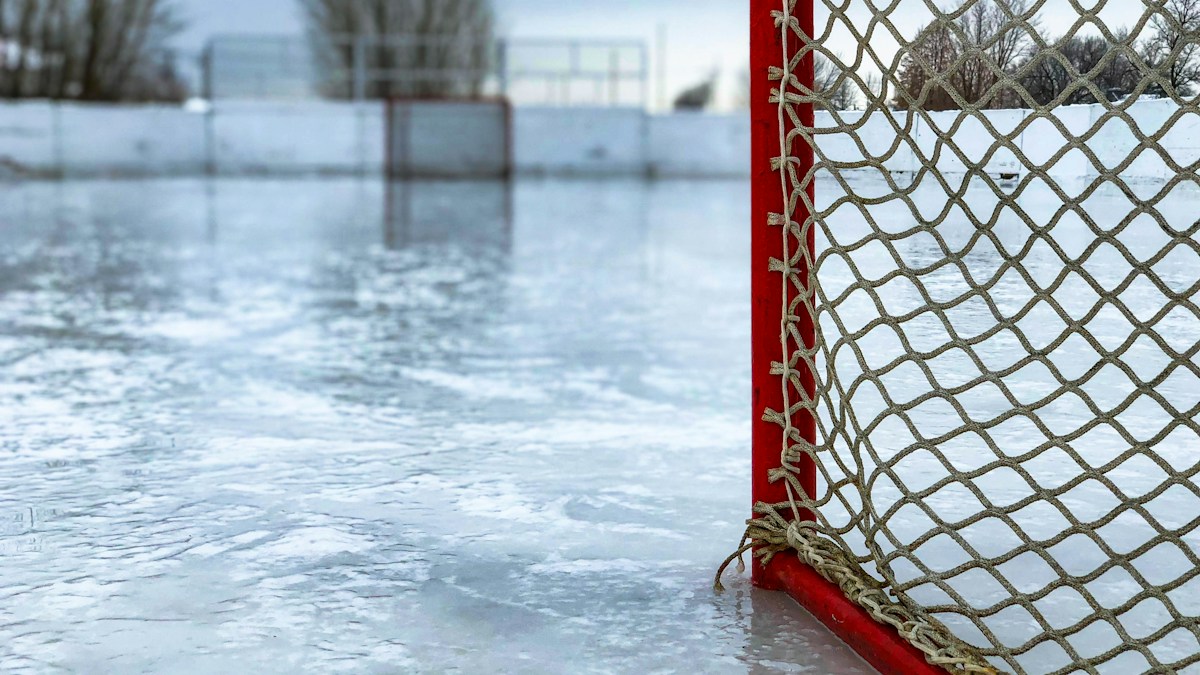
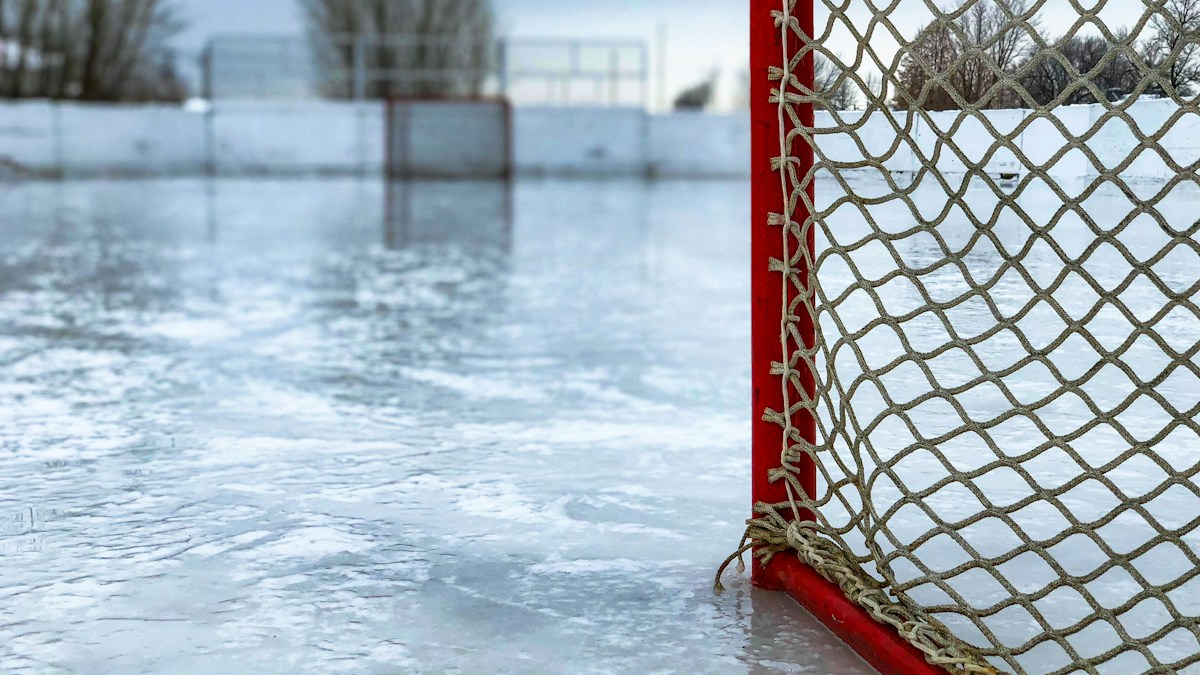
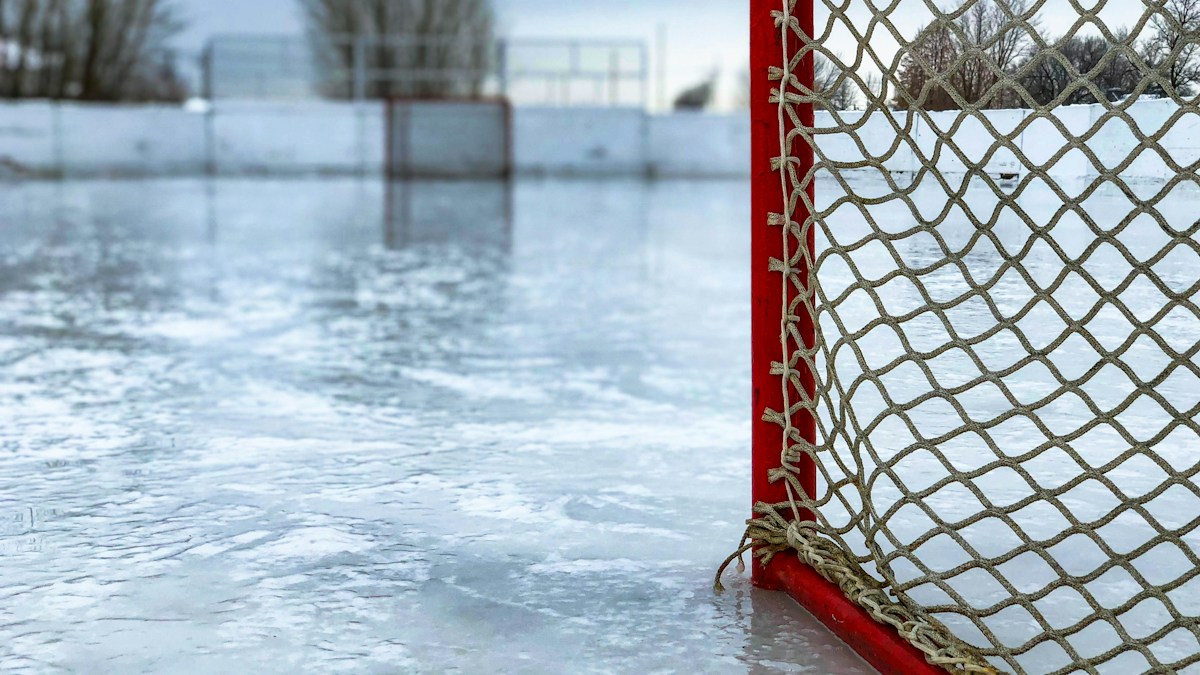
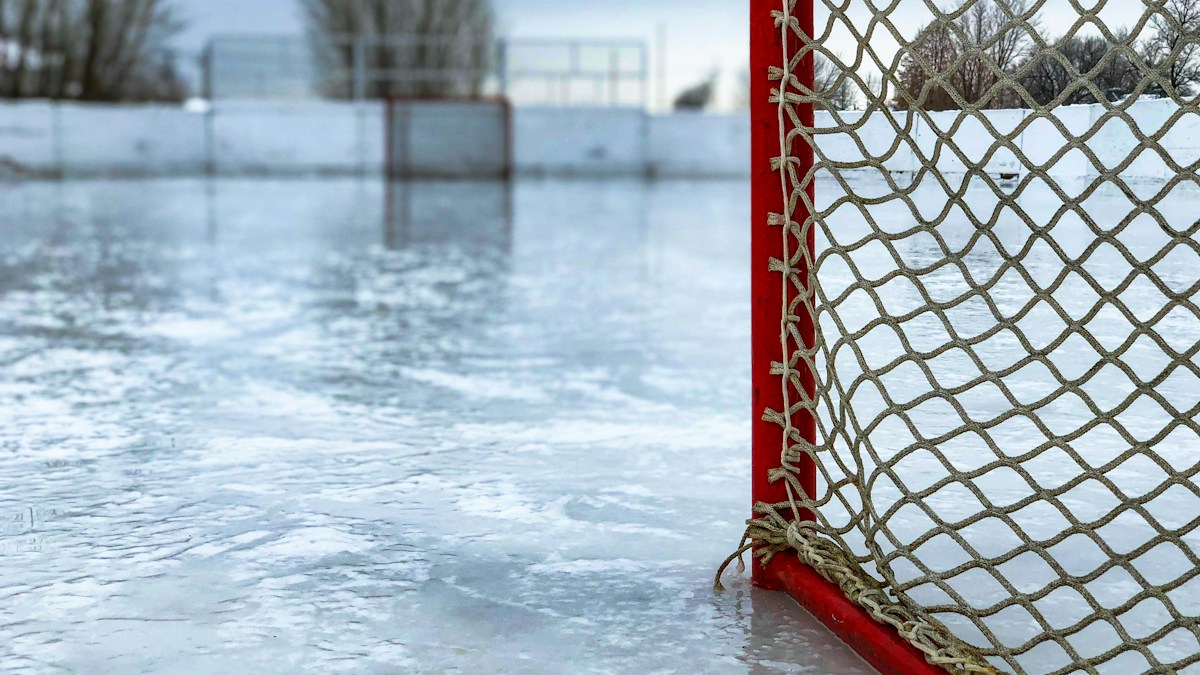
- Goal lines run across each end, with the goal frame — six feet wide and four feet tall — sitting on top of them.
- The crease is the blue semi-circle in front of each goal where the goaltender operates.
- Faceoff circles and spots mark where play restarts after stoppages.
The puck and the gear
The puck is a flat disc of vulcanised rubber, three inches (76 mm) in diameter, one inch (25 mm) thick, and weighing between 5.5 and 6 ounces (156–170 g). It is often frozen before games so it slides more smoothly and bounces less.
Players wear skates, a helmet (with a visor or cage at most levels), shoulder pads, elbow pads, gloves and shin guards, and carry a curved wooden or composite stick. Goaltenders are kitted out like walking mattresses: oversized leg pads, a chest protector, a catching glove, a blocker and a full face mask — and they can use any part of their body or equipment to stop the puck.
How scoring works
A goal is scored when the puck completely crosses the goal line between the posts and under the crossbar. It does not count if the puck was kicked in, batted in by hand, directed in with a high stick above the crossbar height, or put in after play had already been whistled dead.
Alongside the goal, scorers credit assists — up to two players who directly contributed to the goal. If a player scores three goals in one game, that is a hat trick, a tradition celebrated by fans throwing hats onto the ice. When a team is trailing in the final minutes, they often pull the goaltender for an extra skater, which leaves the net empty — a goal scored into it is called an empty-net goal.
Offside, icing and faceoffs: the rules that shape play
Three rules govern how the puck can move and keep the game flowing: offside, icing and the faceoff restart. Get these and you understand 80 per cent of the stoppages you will see.
Offside
A player is offside if they enter the attacking zone — crossing the blue line — before the puck does. The linesman blows the play dead and the faceoff is moved back outside the zone. The rule stops attackers from simply parking in front of the goal waiting for a pass. (If the attacking team is in the process of exiting the zone when the puck crosses, it is allowed — the puck just has to enter first.)
Icing
Icing is when a team shoots the puck from its own half of the ice, over the centre red line, all the way past the opponent’s goal line, untouched. Play stops and the faceoff comes all the way back to the offending team’s end — a punishing result. It exists to stop teams from clearing the puck down the ice endlessly to kill time.
Icing is waived off when: the team icing the puck is shorthanded (playing with fewer players due to a penalty); a defending player could reasonably have played the puck first; the puck goes into the goal (that is just a goal); or the linesman judges the pass was playable. Professional leagues mostly use hybrid icing, where the linesman stops the play early if the defending player wins the race to the puck.
Faceoffs
After every stoppage, play restarts with a faceoff: two players from opposite teams stand across from each other while an official drops the puck between them, and they fight for possession. Where the faceoff happens depends on why play stopped — centre ice after a goal, the offending team’s end after icing, and so on.
Penalties and the power play
When a player breaks the rules, an official sends them to the penalty box and their team must play with one fewer skater for a set time. This creates the sport’s most exciting dynamic: the power play (the team with more players) against the penalty kill (the short-handed team).
The main penalty types:
- Minor penalty (2 minutes): the most common — tripping, hooking, slashing, holding, interference, high-sticking, roughing, delay of game. The team plays 5-on-4, and if the power play scores, the penalty ends early.
- Double minor (4 minutes): two consecutive minors, often for an infraction that drew blood, such as a high stick.
- Major penalty (5 minutes): serious offences such as fighting or boarding; the full five minutes are served even if the other team scores.
- Misconduct (10 minutes) and game misconduct / match penalties for the most serious offences — the player is ejected, and a teammate serves the time.
- Penalty shot: awarded when a foul stops a player from a clear breakaway scoring chance — one skater versus the goaltender, alone.
If two players from the same team are penalised at once, the opposition gets a 5-on-3 advantage. When two players from opposite teams take matching penalties at the same time, they both sit but the teams stay at full strength.
Overtime and shootouts
Tied games do not stay tied, but how they are decided depends on the competition:
- NHL regular season: five minutes of sudden-death overtime played 3-on-3 — wide open, end-to-end hockey. Still level? A shootout: three players per team take penalty shots one-on-one against the goaltender, then sudden-death rounds until someone scores. The winner gets two points, the loser one.
- NHL playoffs: no shootouts. Teams play full 20-minute periods of 5-on-5 sudden-death overtime, over and over, until someone scores. Playoff games routinely run past 100 minutes of play.
- International (IIHF) play: overtime is 3-on-3 — five minutes in round-robin games, ten minutes in knockout rounds — followed by a shootout (three rounds in round-robin play, five in knockouts). The championship game is different: 20-minute 3-on-3 periods until a goal, no shootout.
NHL vs international rules: the key differences
If you switch between the NHL and international tournaments such as the Olympics or World Championship, a few differences stand out:
- Rink size: North American rinks are narrower (200 x 85 ft); international rinks are wider (about 60 x 30 m).
- The trapezoid: in the NHL only, goaltenders may not play the puck behind the net outside a marked trapezoid area — a rule nicknamed the “Martin Brodeur rule” after the goalie whose puck-handling made it necessary.
- Fighting: in the NHL, fighting earns majors but is part of the game’s fabric; under IIHF rules, fighting is banned and punished much more severely.
- Overtime and shootouts: different lengths, player counts and shootout formats, as described above.
How to watch hockey as a beginner
Once you know the rules, here is what to actually watch during a game:
- Watch the power play. When a team is a man up, the game shifts into a chess match — the power play moves the puck around looking for the killer pass, the penalty kill blocks shots and clears the zone.
- Watch the goaltender. The goalie is the most important player on the ice. Position, rebound control and the first save are everything.
- Learn the penalty abbreviations. On-screen graphics show things like HKG (hooking), TRP (tripping), SLASH (slashing), HI-ST (high-sticking) and ROUGH (roughing) — you will soon recognise them instantly.
- Notice the line changes. Players change “on the fly” every minute or so, which is why the game never stops — a fresh five-man unit is always coming over the boards.
- Watch the last two minutes. A trailing team pulls its goalie for an extra attacker, and the final minutes of a one-goal game are chaos.
Field hockey vs ice hockey
It is worth knowing the difference, because “hockey” means different things in different countries. Ice hockey is played on ice with skates, a puck and six players per side. Field hockey is played on grass or artificial turf, by eleven players per side, using a small hard ball and a stick with a rounded head — and it has its own rules for penalty corners, obstruction and goals. This guide covers the ice game; if you are looking at the turf version, the scoring, structure and officiating are all different.
Key takeaways
- Six a side: three forwards, two defencemen and a goaltender; most goals after three 20-minute periods wins.
- Scoring: the puck must fully cross the goal line; a goal is one point, with up to two assists credited.
- Offside and icing are the two rules that cause most stoppages — attackers must not enter the zone ahead of the puck, and teams cannot fire the puck the full length of the ice to waste time.
- Penalties create power plays: two-minute minors, four-minute double minors, five-minute majors and penalty shots; a penalised team plays short-handed.
- Ties are decided by sudden-death overtime and, in the regular season, shootouts — but in playoff hockey, teams play full overtime periods until someone scores.