Table tennis is one of the world’s most played sports — an estimated 300 million people play it recreationally, and it is an Olympic sport with genuine global superstars. It also happens to be one of the easiest sports to start and one of the hardest to master. Whether you have just found an old bat in the garage or you are thinking of joining a local club, this guide covers everything a beginner needs: the rules, the equipment, and a practical plan to get better.
The sport’s profile has rarely been higher. The 2026 World Team Table Tennis Championships were staged in London earlier this year — 100 years after the very first World Championships were held in the same city in 1926 — with 64 men’s and 64 women’s teams competing at the OVO Arena Wembley and the Copper Box Arena. China’s men’s and women’s teams once again dominated, chasing their 12th titles of the century, with world number ones Wang Chuqin and Sun Yingsha leading the way. If you want to understand what they do so well, start with the fundamentals below.
The playing area: table, net and ball
Official competition equipment is strictly regulated by the International Table Tennis Federation (ITTF), and the dimensions have not changed in decades:
- Table: 2.74 metres long, 1.525 metres wide, standing 76 centimetres high. The playing surface is dark-coloured with a white line along each edge, plus a white centre line down the middle for doubles.
- Net: 15.25 centimetres high, spanning the full width of the table, with the posts extending 15.25 centimetres beyond the side lines.
- Ball: 40 millimetres in diameter, weighing 2.7 grams, and made of matte plastic — white or orange. The modern 40mm ball replaced the old 38mm version in 2000 to slow the game down for television.
At home, any flat table and a decent net kit will do for practice — but if you are serious about improving, a proper ITTF-approved table makes a real difference because the bounce is consistent.
How scoring works: the 11-point game
Modern table tennis uses an 11-point rally-scoring system — every rally ends with a point for one player or the other, regardless of who served.
- A match is usually the best of five games (first to three), or best of seven in major events such as the World Championships and Olympic finals.
- A game is won by the first player to 11 points, unless the score reaches 10-10 — “deuce” — in which case a player must win by two clear points.
- Players serve two points each in turn, swapping server after every two points. At deuce, the serve changes after every single point.
- Players switch ends after each game, and in the deciding game they switch ends when the first player reaches five points.
- The winner of a coin toss or spin of the racket chooses who serves first, who receives first, or which end to start from.
This system, introduced in 2001 (games were previously played to 21), was designed to make matches faster and more exciting — and it means every point carries real weight. Never relax at 10-4 up: it only takes one missed serve and one loose rally to be back at 10-6.
The serve: the most technical rule in the sport
The serve is where beginners lose the most points to umpires — and where advanced players win the most points from opponents. The official ITTF service rules are precise:
- The ball must rest flat on the open palm of the free hand, with fingers together and the ball above the table surface and behind the server’s end line.
- The server must toss the ball at least 16 centimetres straight up — roughly the height of the net — without imparting spin, and must hit it on the way down.
- The ball must be visible to the receiver at all times during the toss; hiding the ball with the body or the free arm is illegal.
- The serve must bounce once on the server’s side and once on the receiver’s side, and it must not touch the table’s side edges.
- If the ball touches the net on a serve but still lands correctly, it is a “let” — the point is replayed. There is no limit on lets.
- In doubles, the serve must travel diagonally: from the server’s right half of the table to the receiver’s right half.
Practising a legal, consistent serve is the single fastest way to win more points at beginner level. A serve that lands short with backspin is almost impossible to attack, while a long, fast serve to the opponent’s wide forehand can win points outright at club level.
In play: what is legal and what is not
The rally itself is simple in theory — hit the ball over the net so it bounces on your opponent’s side — but the rules have some subtle details:
- One bounce each: the ball must bounce once on your side before you return it. Hitting the ball before it bounces (“volleying”) loses the point.
- Edge ball: a ball that touches the top edge of the table is in. A ball that clips the side of the table is out.
- Free hand: touching the playing surface with your free hand loses the point, as does moving the table.
- Net cord: during a rally, a ball that touches the net and still lands on the opponent’s side is a legal shot — play continues.
- Obstruction: stopping a ball that is heading out of play over the table with your body or racket loses the point if the ball would have bounced on your side.
- Doubles rotation: partners must take turns hitting the ball. Hitting twice in a row loses the point, and the serve alternates between the four players.
The golden rule for beginners: keep the ball on the table and you will beat most people who try to hit winners. Consistency wins at every level below the top 100 in the world.
Equipment: choosing your first racket
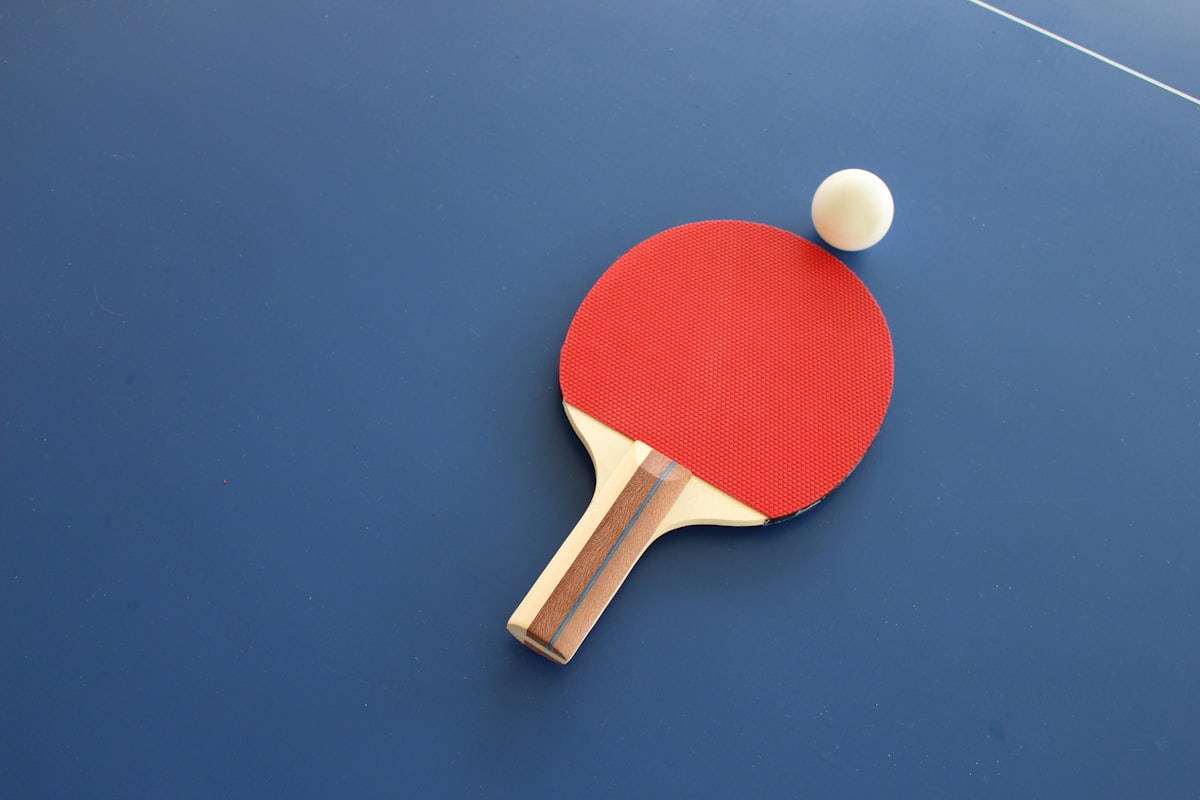
A racket — technically called a bat or blade in official ITTF language — is the most important piece of equipment you will buy. Here is what matters:
- The blade: at least 85% natural wood, per ITTF rules. All-round blades (OFF-minus or ALL ratings) are ideal for beginners because they offer control over speed.
- The rubbers: each side must be covered with rubber. Pimpled rubber (pips out) can be up to 2mm thick; sandwich rubber (pimples inwards) up to 4mm including sponge. One side must be red and the other black — this is not optional, it is a rule that helps both players read spin.
- ITTF approval: look for the ITTF logo on the rubber — it means the rubber is legal for official competition.
- Grip choice: the shakehand grip (like shaking hands with the handle) is used by the vast majority of top players, including Wang Chuqin and Sun Yingsha. The penhold grip (holding the handle like a pen) is popular in Asia. Start with shakehand — it is easier to learn and offers a balanced forehand and backhand.
- Don’t buy the £10 supermarket bat with no sponge — it will teach you bad habits. A beginner racket with proper rubbers costs little and will let you feel spin from day one.
How to improve: a practical plan
Improvement in table tennis comes from repetition, not from watching highlights. Here is a structured plan that works for beginners:
1. Master the basic strokes
- The push: the defensive stroke — a short, controlled contact that keeps the ball low with backspin. Your first weapon.
- The drive: the attacking flat stroke — hit through the ball with a closed racket angle and a relaxed wrist. The foundation of all modern forehands.
- The block: simply putting the racket in the path of a fast ball and letting the opponent’s pace do the work.
- The topspin loop: the modern power stroke — brush the ball from low to high to generate heavy spin. Learn this after the drive, not before.
2. Build footwork before flash
Table tennis is a footwork sport disguised as an arm sport. The best players never reach for the ball — they move to it. Practise the side shuffle and the split step (a small bounce as your opponent hits) until they are automatic. A simple drill: stand at the backhand corner and alternate forehand and backhand by moving your feet, not your body.
3. Practise serves for 15 minutes a day
Serve practice is the highest-return training there is. Work on two serves only: a short backspin serve to the forehand and a long fast serve to the wide backhand. Both are legal with the basic toss, and both win points at every level up to regional standard.
4. Use a robot or a patient partner
A practice partner who is happy to feed you 50 forehand drives is worth more than a match against someone who beats you 11-0. If you train alone, a table tennis robot — even a basic one — lets you groove your strokes and footwork without the pressure of a rally.
5. Watch and copy the best
Watch how Wang Chuqin sets up his forehand, how Sun Yingsha reads serves, and how Felix Lebrun — one of the most exciting teenagers in the game — uses his whole body to generate speed. Slow the footage down. You will notice that the world’s best never look rushed: their footwork is so good that they always have time.
Common mistakes beginners make
- Wrist-first hitting: power comes from the legs and hips, not the wrist. Keep the wrist relaxed and let the body rotate.
- Standing too close to the table: you need space to swing. One forearm’s length from the table is a good starting position.
- Ignoring the serve rules: an illegal serve gets called out in any officiated match — and it is a point lost before the rally begins.
- Buying cheap equipment: a dead, spinless bat makes every stroke harder. Upgrade as soon as you are hooked.
- Skipping the backhand: beginners hide behind the forehand, but at club level the backhand is where rallies are won and lost.
Key takeaways
- Games are played to 11 points (win by two), with two serves each and ends swapped after every game.
- The serve must be a 16cm toss from a flat open palm, hit behind the end line, bouncing once on each side — a net touch is replayed as a let.
- Official equipment: 2.74m table, 15.25cm net, 40mm ball, and a racket with one red and one black rubber.
- Learn the push, drive and block before attempting topspin loops, and practise footwork every session.
- Fifteen minutes of daily serve practice is the fastest route to winning more points.
- Table tennis is an Olympic sport with real depth — and with the 2026 World Team Championships having brought the sport back to London 100 years after the first Worlds, there has never been a better time to start.
Sources: ITTF rules of table tennis; BBC Sport coverage of the 2026 World Team Table Tennis Championships.